
Guide to Kansas Divorce Records
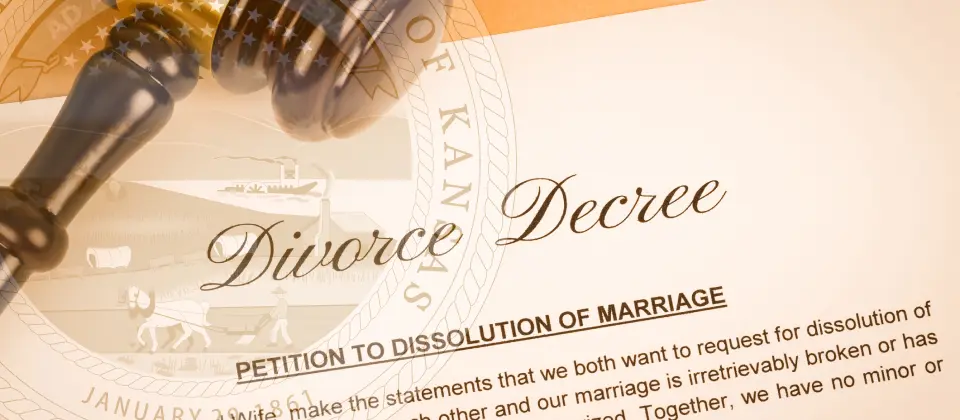
Divorce rules and record access vary by state. Under Kansas law, divorce records are available for inspection and copying. However, access to most records is limited to the parties involved in the divorce and their authorized representatives.
Kansas divorce records are created through the court system when a petition for divorce is filed with the District Court. Upon receiving the petition, the court generates case files and documents throughout the proceedings. These documents ultimately become divorce records.
Kansas divorce records serve as official proof of marriage dissolution, documentation for legal name changes, and supporting identification when applying for a new marriage license.
A typical Kansas divorce record includes the following information:
Full names of both spouses
The county where the divorce petition was filed
Name of the District Court that handled the case
Date the divorce was finalized or granted
Divorce case number
Details of rulings on property division, debt allocation, alimony, and child custody/support
Judgment type (contested or uncontested)
Kansas maintains divorce records in both physical and digital formats. For instance, you can look up some case information online using the District Court Public Access Portal. Searches can be completed by party name or case number. While the portal allows you to view certain case information and some document images, documents filed in a divorce case are available only in physical form at the District Court that handled the case.
In Kansas, divorces are classified as either contested or uncontested, and the documents filed and the process for obtaining each type of divorce vary. Likewise, the content of Kansas divorce records depends on the circumstances of each case. Understanding the divorce process in Kansas is essential, as it clarifies what information is recorded and how it can be accessed.
Where Are Kansas Divorce Records Stored?

Kansas divorce records are maintained at both the county and state levels. County-level records are generally maintained by the District Court in the county where the divorce was finalized, and they can be accessed through the office of the District Court Clerk. County-level records include filings, motions, testimonies, final judgments or decrees, and settlement agreements.
State-level divorce records, or certificates of dissolution, are maintained by the Kansas Department of Health and Environment, Office of Vital Statistics. Unlike county-level records, these certificates are not court documents that are legally enforceable.
Is Kansas a 50/50 Divorce State
Kansas is an equitable distribution state. Unlike community property states, where property is divided equally, Kansas courts divide property according to what is fair under the circumstances of each case. The principle is that marriage is a partnership, and when it ends, assets and debts must be divided based on each spouse's contributions.
In Kansas, couples are encouraged to agree on property division before trial. If they cannot, the court will make the division after considering the following factors:
Age of the Parties: The court considers each spouse's age, as it may affect financial needs and earning potential. Younger spouses may have greater earning capacity, while older spouses may require more security.
Property Owned by the Parties: The court reviews the assets each spouse owns. This includes both marital and separate property.
Time, Source, and Manner of Acquisition of Property: How and when property was acquired matters. Property obtained before marriage or through inheritance may be treated differently.
Tax Consequences: Judges consider how property division will affect each spouse's taxes. This ensures neither party faces undue financial burden.
Present and Future Earning Capacities: Judges assess each spouse's ability to earn income now and in the future. This ensures the division accounts for disparities in financial potential.
Types of Kansas Divorce Records

The State of Kansas offers three types of divorce records: divorce certificates, divorce decrees, and divorce case information. Each of these records serves a different purpose depending on what information you need. For instance, a divorce certificate verifies that a divorce occurred and includes essential details such as the names of the parties, the county where the divorce was finalized, and the date of dissolution. Certificates are typically used for administrative purposes, including name changes, applications for new marriage licenses, and identity verification.
Unlike divorce certificates, a decree is a comprehensive court order outlining the judge's final rulings. It is the authoritative record of the court's judgment and is relied upon when determining the terms of a divorce.
The divorce case information is different from both the certificate and the decree because it provides a complete record of the proceedings from start to finish. It includes every filing and court action, making it especially useful if you need to review the full history of the case or obtain documentation for appeals and complex legal issues.
Kansas Divorce Certificate (Certificate of Divorce)
A Kansas divorce certificate is an official document that confirms the dissolution of a marriage between two individuals. It contains essential details about the divorce, including the names of both parties, the date of marriage, and the date of finalization. A divorce certificate also provides information on the county where the divorce was filed, the filing date, and the court case number. Kansas divorce certificates are issued by the Office of Vital Statistics.
Divorce Decree (Final Judgment of Divorce)
A divorce decree is the official court document that ends a marriage. It explains the judge's final decisions, including who gets what property, whether alimony is paid, financial duties, child support, visitation schedules, and custody arrangements. Divorce decrees are available at the District Court that handled the case. Once it is signed by a judge and filed with the court, a divorce decree becomes a legally binding court order enforceable against both parties.
A Kansas divorce decree typically contains the following rulings:
Property and Debt Division: A divorce decree specifies how marital assets and liabilities are allocated between the parties.
Maintenance: It outlines any spousal support awarded, including the type, amount, and duration of payments.
Child Custody and Support: If the couple has children under 18, the decree outlines custody arrangements, visitation schedules, and child support obligations.
Final Judgment Date: The official date the judge signs the decree. It is also the date the marriage is officially dissolved.
Divorce Case Information
The divorce case file is a comprehensive record maintained by the Clerk of the District Court. It contains all documents filed during the proceedings, including the complaint, summons, motions, financial disclosures, parenting plans, and the final decree. Unlike the decree, which is the court's final judgment, the case file functions as the complete archive of the divorce process. These files are available at the District Court in the county of filing.
How to File for Divorce in Kansas (Step-by-Step)
Kansas law requires at least one spouse to have lived in the state for a minimum of 60 days before a divorce petition can be filed. The court will not move forward with your divorce if you have not met the residency requirement or qualify for an exception.
In addition to residency requirements, you should identify whether the divorce will be contested or uncontested. The type of case you file will greatly affect the cost, complexity, and duration of the process.
Uncontested Divorce: In an uncontested divorce, both spouses reach an agreement on all major issues, including property division, child custody, and support. Once the parties finalize their settlement, they may submit it to the court for approval. The judge can issue a divorce decree upon reviewing the settlement agreement.
Contested Divorce: A contested divorce occurs when the spouses cannot agree on one or more issues. Common points of disagreement include alimony, child support, custody, and division of assets. In these cases, a judge will make the final decisions.
You can begin the filing process once the residency requirement is satisfied and the nature of the divorce is clear.
Step-by-Step Divorce Process
While Kansas has statewide statutes for divorce, district courts do not follow uniform rules. The district court where you file for divorce may have local court rules that apply specifically to your case. As such, you should contact the Clerk of the District Court to ask how you can find a copy of the local court rules. Some courts have their local court rules available on their website. However, the divorce process in the state generally depends on whether the divorce is contested or uncontested and whether the couple has children under 18.
Prepare the Filing Packet
To officially begin a divorce in Kansas, you must file certain documents with the District Court in the county where you or your spouse lives and pay a filing fee. Listed below are the practical steps you must follow to file for divorce:
Identify the Divorce Path (1A vs. 1B): This is where you decide if the divorce will be contested or uncontested.
Prepare the Required Documents: Assemble the following documents:
Petition for Divorce: This is the document that opens your case. It explains what orders you want the court to issue and provides the necessary background information. You must sign the petition in front of the Clerk of the District Court and have the Clerk complete the notarial officer section.
Summons: This is filed in a contested divorce case to formally notify your spouse of the action.
Self-Represented Litigant Certification Form: This form certifies that the documents you are filing do not contain prohibited personally identifiable information (PPI), such as full Social Security numbers or full dates of birth. Such information may only appear on the confidential Civil Cover Sheet.
Civil Cover Sheet: This form supplies the court with the required information about both spouses. Full Social Security numbers and dates of birth, if known, must be included. The form is used only by court staff and is not accessible to the public once entered into the court's system.
Domestic Relations Affidavit: This affidavit provides the court with financial information, including income, expenses, debts, assets, and health insurance details.
Any other required forms are determined by the type of divorce being filed. You can access them through your local District Court website or location.
Filing Fees and Fee Waivers: Filing a divorce petition in Kansas costs $195. If you cannot afford the fee because of low income, you can submit a Poverty Affidavit to the District Court. The judge will review your request and decide whether to waive the fee.
File the Case
Once your forms are complete and the filing fee is addressed, you may file your divorce case as follows:
Where to File: You can file your documents with the District Court in the county where you or your spouse resides.
Filing Methods: You can file your completed paperwork using any of these methods based on your preference and availability:
In Person: Visit the District Court Clerk's office to submit all the required documents and appropriate fees in person.
Mail: If the county District Court Clerk's office allows mail-in submission, submit the appropriate forms and proof of filing fee payment by mail.
Electronic Filing (eFiling): Although Kansas does not allow online divorce filing, interactive tools from Kansas Legal Services or the Kansas Judicial Council can help you prepare your forms at home. These tools are especially useful for uncontested cases. After completing the forms, you must print, notarize, scan, and file them with the court.
What You Receive: After filing, the court will provide:
A case number for tracking your case
A stamped copy of all the documents you filed
A summons if the case is contested
Service of Process (Primarily for Contested Cases)
In Kansas, you must officially notify your spouse that you have filed the petition. Kansas law provides several ways to complete service:
Voluntary Entry of Appearance: If your spouse is willing to accept the papers, give them copies of the Petition and Summons. They can sign a Voluntary Entry of Appearance form in front of a notary or the Clerk. You then file the signed form with the District Court handling the case.
Personal Service by Sheriff: You can have the sheriff give a copy of the Petition for Divorce and Summons to your spouse. There is a fee for service in Kansas. If your spouse lives in another state, you must follow that state's sheriff procedures and pay their fees.
Personal Service by Process Server: An authorized process server may serve the documents. The server must be appointed by the judge or clerk. You must follow the court's appointment procedure, pay any required fees, and file both the Motion and Order for Appointment of a Special Process Server.
Service by Mail: You may send the Petition for Divorce and Summons using a delivery method that provides a return receipt, such as certified mail, priority mail, or a commercial courier. The receipt must show the recipient, the delivery date, the delivery address, and the person or entity completing the delivery. After receiving the receipt, you must file a Return of Service by Return Receipt Delivery with the Clerk.
Service by Publication: If all other methods fail, you may request permission to publish notice in a local newspaper. After publication, you must file proof of publication with the Clerk of the District Court.
Early Case Phase and Temporary Orders
In the early stages of divorce, courts focus on maintaining the status quo, especially when children are involved. During this stage, both parties are expected to exchange relevant information and address immediate needs.
Both spouses can take steps to manage immediate needs, including:
Exchanging financial records and other documents
Requesting temporary orders to address child care or financial needs
Submitting evidence to support requests for relief
After mediation, the judge may hold a hearing to decide whether temporary orders are necessary. These may cover:
Temporary child or spousal support
Exclusive use of marital property, such as the marital home
Child custody and visitation arrangements
Temporary orders serve as interim measures and remain effective until the final divorce decree is issued.
Financial Disclosures and Discovery
Discovery provides each spouse with access to the financial information necessary for a fair divorce settlement or court ruling. Kansas law requires each spouse to provide sworn documents listing all income, assets, and debts. This helps ensure property is divided fairly, and support is calculated correctly. Failure to provide full and honest disclosure may lead to sanctions.
Below are essential elements of financial discovery in a Kansas divorce case:
Mandatory Disclosure: Both parties in a Kansas divorce are required to file a Domestic Relations Affidavit (DRA). This sworn, notarized document discloses important financial information, including income, expenses, assets, and debts. It helps the court to make fair property division and support determinations.
Discovery Tools: You can also use additional tools to gather information necessary for fair decisions on alimony, property division, and other issues:
Request Documents: Make formal requests for records such as tax returns, pay stubs, and bank statements.
Interrogatories: Provide written questions that the other spouse must answer under oath.
Subpoenas: Obtain court orders requiring third parties, such as banks or employers, to provide financial information.
Depositions: Take sworn testimony in person, outside of court, to gather additional financial information.
Case Management and Court Conferences
After a response is filed, the court may order a case management conference. In Kansas, such an order can be made by the court after reviewing the case or at the request of one of the parties. A case management conference is a meeting between the spouses, a case manager, and others involved in the case. The purpose is to set deadlines, organize the case, and attempt a resolution.
During the meeting, the case manager collects information necessary to assist in reaching agreements or making recommendations, including medical, psychological, educational, and court records, as well as custody investigations and evaluations.
The manager then reports to the court as directed and alerts the court if a party fails to meet financial obligations related to case management. If a party disputes a recommendation, they may file a motion for review. The case manager must explain the basis for their recommendations either through a written report or testimony.
Settlement or Trial
Kansas divorce cases are resolved either through settlement or trial. Settlement allows the parties to negotiate terms rather than relying solely on judicial decisions. Settlement options include:
Signing a marital settlement agreement
Negotiating directly with your spouse
Participating in mediation with a neutral facilitator
Attorney-led settlement discussions
Generally, before the case is finalized, the court will review the negotiated settlement to see if it is fair, equitable, and clear. The settlement agreement must contain sufficient information for the court to make such a determination.
When settlement is not possible, the case proceeds to trial. At trial, both spouses testify, present evidence, and submit proposals. The judge then decides on unresolved issues and ensures that marital property is divided fairly.
Judgment, Waiting Periods, and Finalization
Kansas has a mandatory 60-day waiting period between the date your spouse was served and the date the divorce is finalized. This waiting period is designed to prevent impulsive decisions and allow spouses to consider reconciliation.
Child Custody and Child Support in Kansas Divorces
In Kansas divorce proceedings, child custody, residency, and parenting time are treated as separate matters. The district court decides these matters based on what is in the child's best interests. To do this, the court looks at several factors, including:
How each parent has been involved in the child's life before and after the separation
What the parents want regarding custody and residency
The child's age
The child's emotional and physical needs
Whether each parent is willing to encourage the child's relationship with the other parent
Any evidence of domestic abuse
Legal Custody vs. Physical Custody
In Kansas, if parents agree on custody arrangements, they can submit a written permanent parenting plan to the court. However, the court retains the right to reject the plan if it determines that the arrangement is not in the child's best interests. If parents cannot reach an agreement on a parenting plan, or if the proposed plan is not in the child's best interest, the court will order a custody arrangement.
Depending on the circumstances of the case, the court will issue rulings on legal custody and physical custody (residency). These may be shared jointly if the court determines that such an arrangement serves the child's best interests.
Legal Custody: Gives a parent the right to make decisions regarding the child's education, religion, healthcare, and legal matters.
Physical Custody: Refers to where the child resides and who provides daily care. This may be shared through a schedule or primarily assigned to one parent, depending on the child's needs.
Courts generally presume both parents are fit to care for the child. As such, sole custody is awarded only when the court determines that joint custody is not in the child's best interests. In such cases, the court must state its reasons on the record.
Child Support Guidelines and Enforcement
Under Kansas law, the court may order that child support and education expenses be paid by either or both parents for any child under 18 years of age. This responsibility is divided based on each parent's income, regardless of the court-ordered custodial arrangement.
Kansas determines child support obligations using state-approved guidelines. These guidelines establish the amount of support after considering specific factors:
Both parents' gross incomes
Reasonable business expenses
Child support obligations for other children
Court-ordered maintenance
After the court enters a child support order, it becomes legally binding. This means both parents must fulfill their payment obligations. If a parent does not comply, Kansas uses different enforcement tools to make sure the child receives the support:
Wage withholding (automatic deduction from paycheck)
Interception of federal and state tax refunds
Initiating court actions that may result in penalties, including fines or jail time
Property, Debt, and Alimony in Kansas Divorces
Kansas is an equitable distribution state, meaning property is divided in a fair and reasonable manner. This includes both real and personal property, as well as retirement and pension accounts. The law distinguishes between marital property and separate property.
Marital property refers to income and assets acquired during the marriage.
Separate property refers to assets owned before marriage or obtained through inheritance, gifts, or wills, along with any profits or income they generate. Separate property remains the sole property of the individual spouse and is not subject to the other spouse's debts.
However, when divorce proceedings are initiated, Kansas law treats all property, whether acquired before or during marriage, as marital property. Judges may divide all assets, including inheritances and premarital property, to achieve an equitable distribution.
In addition to property, the court must also address marital debts. Marital debts are obligations incurred during the marriage that serve the joint interests of both spouses. To determine a fair allocation of these debts, courts examine several factors:
Each party's ability to repay the debt
The spouse who incurred the debt, and for what purpose
Whether only one party or both spouses (or the marriage) benefited from the debt
The overall distribution of marital property
In Kansas, the court can order one spouse to provide financial support to the other after divorce. This is called maintenance, and the judge decides the amount by considering what is fair, just, and equitable under the circumstances.
Common types of alimony in the state include:
Periodic Alimony: This involves regular payments made to a spouse over a specified period, typically in monthly or bi-monthly installments.
Lump-Sum Alimony: A single, final payment of a fixed amount, rather than ongoing installments.
Errors, Omissions, and Corrections in Kansas Divorce Records
Divorce records often contain mistakes such as incorrect dates, misspelled names, missing details, or other clerical errors. Correcting these errors promptly is essential to ensure that your legal, financial, and personal affairs are accurately reflected and legally binding.
Several state statutes and regulations govern the process of amending divorce records, and procedures vary depending on the type of correction. For example, corrections to divorce certificates must be handled by the Kansas Department of Health and Environment's Office of Vital Statistics.
In addition, the process and requirements for correcting a divorce certificate vary depending on the type of correction you seek:
Misspelled Names or Incorrect Birth Details: You must submit an application form, the party's birth certificate as proof, and a notarized request from both parties. If one party is unavailable, someone knowledgeable about the marriage and divorce may complete the notarized request.
Incorrect Divorce Date: You must submit an application form, a certified copy of the divorce decree from the county, and a notarized letter from one or both parties explaining the correction.
All applications for the correction of divorce certificates can be sent to:
Kansas Department of Health and EnvironmentAmendment Unit, Office of Vital Statistics
1000 SW Jackson, Suite 120, Topeka, KS 66612-2221
The fee to amend a divorce certificate is $20. This does not include the charge for a certified copy.
To correct a divorce decree, you must file a motion to modify with the District Court that issued the final judgment. The judge will review the request and determine whether a correction or amendment is appropriate.
Once the court approves the correction, you may obtain updated copies of the certificate or decree from the appropriate office:
Obtain your updated divorce certificate from the Kansas Department of Health and Environment, Office of Vital Statistics.
Get your updated Kansas divorce decree from the District Court Clerk's Office in the county where the divorce was finalized and the decree updated.
How to Access Kansas Divorce Records

Kansas divorce records may be accessed online, in person, or by mail. The type of divorce record you seek determines where to look.
Online Access
Divorce Decrees: Kansas divorce decrees are not available online and must be obtained directly from the district court by mail or in person. These records are issued only to parties in the divorce and authorized persons.
Divorce Certificates: You can request Kansas divorce certificates issued by the Office of Vital Statistics online through VitalCheck, the state's third-party vital record ordering service. Expect to pay $20 for each copy of your divorce certificate. There is an additional $15.00 expedited service fee for credit card requests, which is charged by VitalChek.
In-Person Request
Divorce Decrees: You can obtain a final divorce judgment or decree in person by visiting the district court that handled the case. The cost of a divorce decree varies by county, so it's crucial to contact the district court clerk before your visit. This will also help you find out whether the court accepts walk-in requests at any time or requires you to schedule an appointment before your visit.
Divorce Certificates: You can visit the Kansas Office of Vital Statistics to obtain a divorce certificate. Walk-in requests require you to provide a valid ID or your Social Security number. The Office of Vital Statistics provides walk-in service from 9 A.M. to 4 P.M., Monday-Friday. This service may take around 15 to 20 minutes, provided there are no difficulties locating the record.
Mail-in Request
Divorce Decrees: Contact the District Court Clerk's office in the county where the divorce was finalized to confirm if they offer mail-in services for full divorce decree requests.
Divorce Certificates: To get a divorce certificate application by mail, send an application form with a $20.00 check or money order made out to the Office of Vital Statistics:
Curtis State Office Building
1000 SW Jackson, Suite 120, Topeka, KS 66612-2221
Your application must specify which certificate you are requesting, the number of certified copies, and your full name as listed on the divorce certificate. You must also state your relationship with the person named on the certificate you seek.
You can also request a divorce certificate in Kansas by calling (877) 305-8315. To prevent identity fraud, the credit card used must be registered in your name, and the cardholder's information will be verified. You must also provide a Social Security number or driver's license number. Once your information has been verified and you have paid the applicable fees, the Office of Vital Statistics will deliver the certificate via UPS.
Kansas Courthouses That Handle Divorces
Before starting a divorce in Kansas or searching for divorce records, it is essential to identify the court with jurisdiction over such matters and the proper venue for filing. In Kansas, divorce cases are handled at specific levels of the state court system. You must file your paperwork with the correct court so the case is handled properly.
Court Authority for Kansas Divorce Cases
In Kansas, divorce cases are handled by the District Courts. District judges oversee divorce and custody matters, while the Clerk of the District Court keeps the official records, including the final decree.
County-Based Filing
Most divorce records in Kansas are maintained at the county level. As such, it is crucial to identify the proper venue for filing a divorce case or requesting copies of decrees. In general, the appropriate venue is the District Court of the county in which either spouse resides.
Divorce certificates are state-level records issued by the Office of Vital Statistics. Here are places to find final divorce decrees for some popular Kansas counties:
Jackson County: Jackson County District Court
Atchison County: Atchison County District Court
Johnson County: Johnson County District Court
Decatur County: Decatur County District Court
Jurisdiction Basics
To file for divorce in Kansas, one spouse must have lived in the state for at least 60 days. If the other spouse lives outside Kansas, jurisdiction can still be established through consent, service in Kansas, or long-term provisions.
Divorce cases may be filed in the county where either spouse lives or where the respondent can be served. Additionally, if the petitioner resides at or is stationed on a United States military post or reservation within Kansas, the action may be filed in any county adjacent to that post or reservation.
Examples of Kansas District Courts
Each county in Kansas is served by at least one District Court. Here are examples of District Courts in the state:
Jackson County District Court (2nd Judicial District of Kansas)
Atchison County District Court (1st Judicial District of Kansas)
Johnson County District Court (10th Judicial District of Kansas)
Decatur County District Court (17th Judicial District of Kansas)
Role of the District Court Clerk
The District Court Clerks play the following key roles in Kansas divorce cases and records:
Accept divorce filings/petitions and assign case numbers to each filing
Issue court notices and summonses
Handle official case files for all divorce matters decided in the district court
Provide certified copies of divorce decrees and related orders to eligible individuals
FAQs
Are Divorce Records Public in Kansas?
Yes, divorce records in Kansas are considered public. However, documents filed in a divorce case and sensitive information, such as details involving minors, mental health, or domestic violence, are restricted.
What Is the Difference Between a Certificate and a Decree?
Kansas divorce certificates are vital records that confirm the dissolution of a marriage. On the other hand, a divorce decree is the court document that details the divorce settlement. The state's Office of Vital Statistics issues divorce certificates, while divorce decrees are issued by district court clerks.
Do I Need to Know the County?
To obtain a divorce decree in Kansas, you need to know where the divorce was filed and finalized. The divorce decree is available at the District Court Clerk's office in the county where the divorce was finalized.
How Far Back Do Records Go?
Kansas divorce certificates date back to January 1951 and are maintained by the Office of Vital Statistics. Older records can be obtained from the Kansas Historical Society.
How Much Does It Cost?
A Kansas divorce certificate costs $20, while the price of a divorce decree varies by county. You can confirm the exact amount by contacting the district court clerk in the county.
Can I Search Kansas Divorce Records for Free?
Although certain district court case information may be searched online without charge, Kansas divorce decrees and certificates are not free.
Table of Contents
- Where Are Kansas Divorce Records Stored?
- Is Kansas a 50/50 Divorce State
- Types of Kansas Divorce Records
- How to File for Divorce in Kansas (Step-by-Step)
- Step-by-Step Divorce Process
- Child Custody and Child Support in Kansas Divorces
- Property, Debt, and Alimony in Kansas Divorces
- Errors, Omissions, and Corrections in Kansas Divorce Records
- How to Access Kansas Divorce Records
- Kansas Courthouses That Handle Divorces
- FAQs